
Define Design

By Jonah Reed
Design is the deliberate planning of an object, message, space, system, or experience to meet a defined need. It is both a process and the outcome of that process. A designer identifies a problem, considers the people and conditions involved, develops possible responses, and tests whether the chosen response works.
Appearance matters, but design is not decoration alone. It connects purpose, function, form, materials, information, and use. A poster must communicate. A chair must support a person safely. A website must help visitors understand its content and complete relevant tasks. In each case, visual character should strengthen the intended function rather than obscure it.
Start by defining the design problem
A useful design brief states the problem in observable terms. Instead of asking for a modern-looking website, it might ask how visitors can find service details and contact information without confusion. A packaging brief might identify a need to protect an item, communicate handling instructions, fit a distribution method, and use materials responsibly.
Clarify four points before developing ideas:
- People: Who will use, read, operate, maintain, or encounter the result?
- Purpose: What should those people be able to understand or do?
- Context: Where, when, and under what conditions will the design be used?
- Constraints: Which technical, legal, physical, environmental, time, and budget limits apply?
Constraints do not merely restrict a project. They help distinguish relevant solutions from attractive but impractical ones. A sign viewed from a distance needs different lettering from a printed booklet. A control used outdoors may require weather resistance and operation with gloves. A public digital service must account for varied devices, input methods, reading abilities, and connection speeds.
Define success in the same practical terms. Useful measures might include whether people can find a route, understand an instruction, complete a form, assemble an object correctly, or recognise the difference between two options.
Balance function and form
Function describes what a design must do. Form describes its visible or physical structure, including shape, scale, proportion, layout, colour, texture, and arrangement. The two affect each other. A handle’s shape influences how it can be gripped, while the spacing and weight of text influence how easily it can be read.
Good form makes function legible. People should be able to recognise important parts, understand their relationships, and predict how to act. On a page, headings establish sections, spacing groups related content, and contrast distinguishes primary actions from secondary ones. On a physical object, shape, position, and movement can indicate where to hold, press, turn, or open it.
Visual hierarchy directs attention in a deliberate order. Size, weight, position, contrast, repetition, and white space can show what matters first and what supports it. If every element is equally prominent, the reader has to construct the hierarchy unaided. If decoration draws more attention than an instruction or control, the hierarchy is working against the task.
Consistency makes a design easier to learn. Repeated actions should use repeated terms and patterns. A control should not change meaning from one screen to another, and a document should not use several unrelated styles for headings of the same level.
Account for usability and accessibility
Usability concerns whether people can complete tasks accurately and recover from errors. Clear labels, sensible sequences, visible feedback, and helpful error messages reduce avoidable uncertainty. A form should identify the field that needs attention. A selected control should show its state. Instructions should appear where they are needed rather than in a distant explanation.
Accessibility considers the range of ways people perceive and operate a design. Digital work should support keyboard use, meaningful headings, readable text, sufficient contrast, and alternatives for information conveyed through sound or images. Colour should not be the only indicator of status. Physical spaces and products require equivalent attention to reach, movement, visibility, force, and understandable operation.
Accessibility is most effective when treated as a design requirement from the start. Adding it at the end can expose structural problems that are expensive or impossible to correct without reconsidering the work. Testing with people who use different access methods helps reveal barriers that a checklist alone may miss.
Choose materials and methods for the context
Materials influence strength, weight, comfort, cost, appearance, manufacture, maintenance, repair, and disposal. Selection should follow the conditions of use. A surface exposed to frequent cleaning needs suitable resistance. Packaging must protect its contents during handling without becoming unnecessarily difficult to open or separate for disposal.
Production methods also shape what can be designed. Printing, folding, casting, machining, stitching, and digital rendering each impose different tolerances and possibilities. Designers need enough knowledge of the intended method to avoid details that cannot be produced reliably or maintained. Early discussion with the people who will build, install, or operate the result can prevent late revisions.
Consider the full life of the outcome: how materials are obtained, how components are assembled, what routine care is required, whether parts can be repaired or replaced, and what happens when use ends. The responsible choice depends on actual facilities and conditions, not on a material label considered in isolation.
Understand the main design disciplines
Different design disciplines apply shared principles to different kinds of problems, and complex work often requires several specialists.
Graphic and communication design
Graphic design organises words, images, symbols, colour, and typography to communicate. It includes identities, publications, packaging, signs, instructions, and campaign materials. The designer establishes reading order, selects an appropriate visual language, and adapts the work to its medium and audience. Legibility and accurate reproduction matter as much as visual distinction.
Product and industrial design
Product design shapes physical or digital products around use, manufacture, safety, and maintenance. The work may involve research, ergonomics, sketches, models, prototypes, specifications, and collaboration with technical specialists. A convincing concept must still tolerate production, handling, repair, and expected wear.
Interior and spatial design
Interior design plans how people use and experience indoor space. Layout, circulation, lighting, acoustics, furniture, storage, finishes, ventilation, safety, and accessibility all contribute. The work must respond to the building and its regulations rather than treating surface decoration as the whole task.
Digital experience design
Digital experience design covers websites, applications, software, and connected services. It combines user research, information architecture, interaction, interface, content, and testing. The expanding range of digital design disciplines reflects the need to consider complete journeys, including loading, errors, privacy choices, device differences, and support after a task fails.
Use an iterative design process
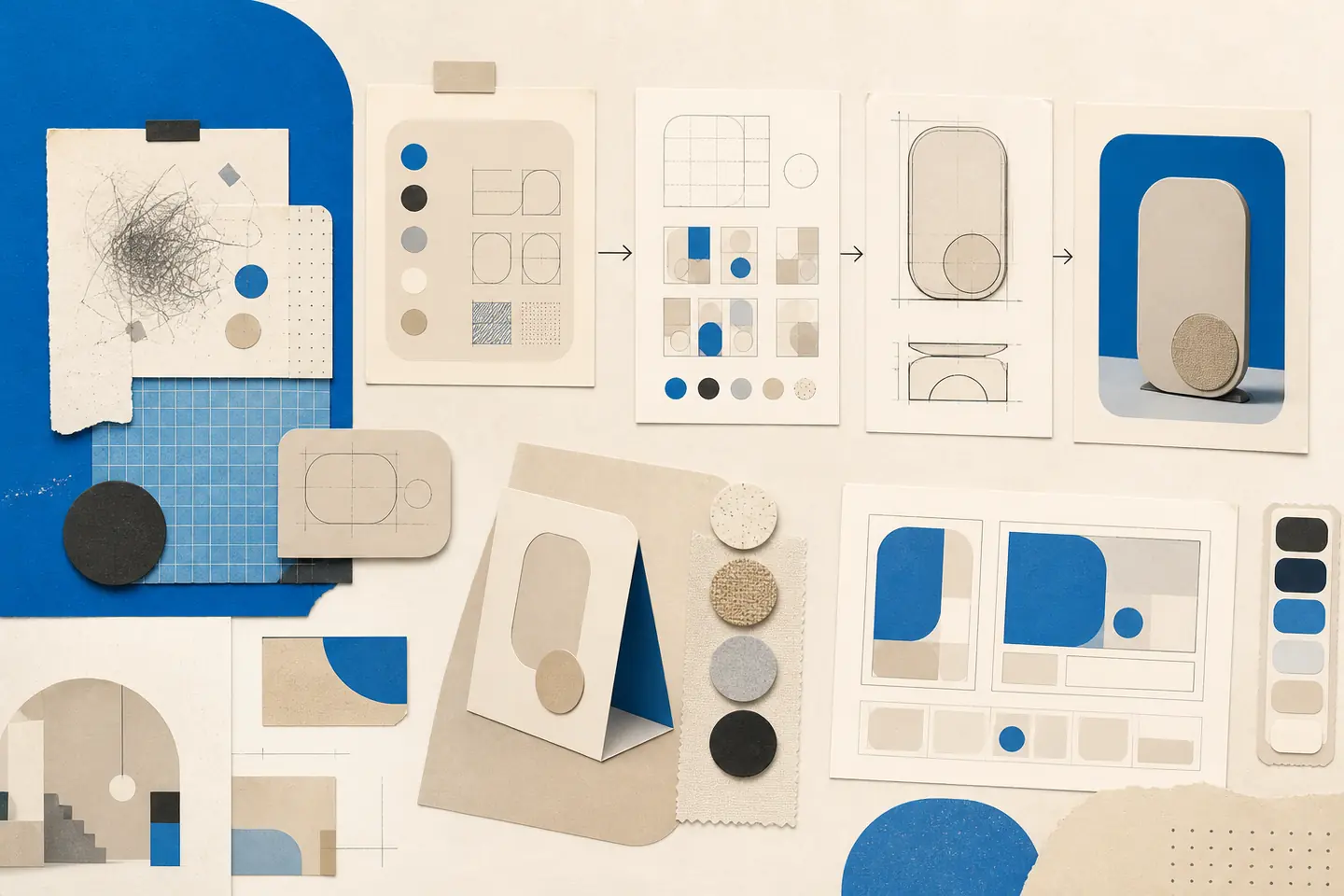
Design rarely proceeds in a perfect straight line. Research, ideas, prototypes, tests, and implementation inform one another. The precise stages of the design process vary by discipline, but a practical sequence includes the following work.
- Research: Observe the situation, speak with relevant users and specialists, review existing evidence, and identify the real task.
- Define: Record the audience, purpose, context, constraints, risks, and criteria for success.
- Develop: Produce several approaches before committing to one. Compare them against the brief rather than taste alone.
- Prototype: Make the idea concrete with sketches, wireframes, samples, models, or working demonstrations at an appropriate level of detail.
- Test: Ask representative users to complete realistic tasks. Observe behaviour, errors, hesitation, and recovery rather than relying only on stated preferences.
- Refine and deliver: Correct significant problems, confirm feasibility, prepare accurate specifications, and check the produced result against the approved design.
A prototype should answer a question. A rough paper layout may reveal whether information is organised clearly; a material sample may test texture or durability; a working interface may expose problems with focus order or error handling. Building more detail than the question requires wastes effort and can make teams reluctant to revise weak ideas.
Testing should use realistic tasks and conditions. Give participants a goal rather than instructions that reveal the intended route. Record where they pause, misunderstand a label, miss information, or cannot recover. Rank findings by their effect on safety, access, task completion, and comprehension, then revise and test the important changes again.
A practical design review
Before approving a design, check it against the brief rather than asking whether it simply looks good:
- Does it solve the defined problem for the intended people and context?
- Can users identify the main information, action, or point of interaction?
- Are labels, instructions, states, and errors clear?
- Does the visual hierarchy support the task?
- Can people use it through relevant access methods?
- Are materials and production methods suitable for expected use and maintenance?
- Have representative users tested realistic tasks?
- Can the result be produced, checked, repaired, and updated as required?
Document the reasons for major decisions and any unresolved limits. This record helps builders interpret the design accurately, gives reviewers a shared basis for feedback, and makes later changes easier to assess. A design is ready when evidence shows that it meets its purpose within the stated constraints, not when further decoration has stopped.